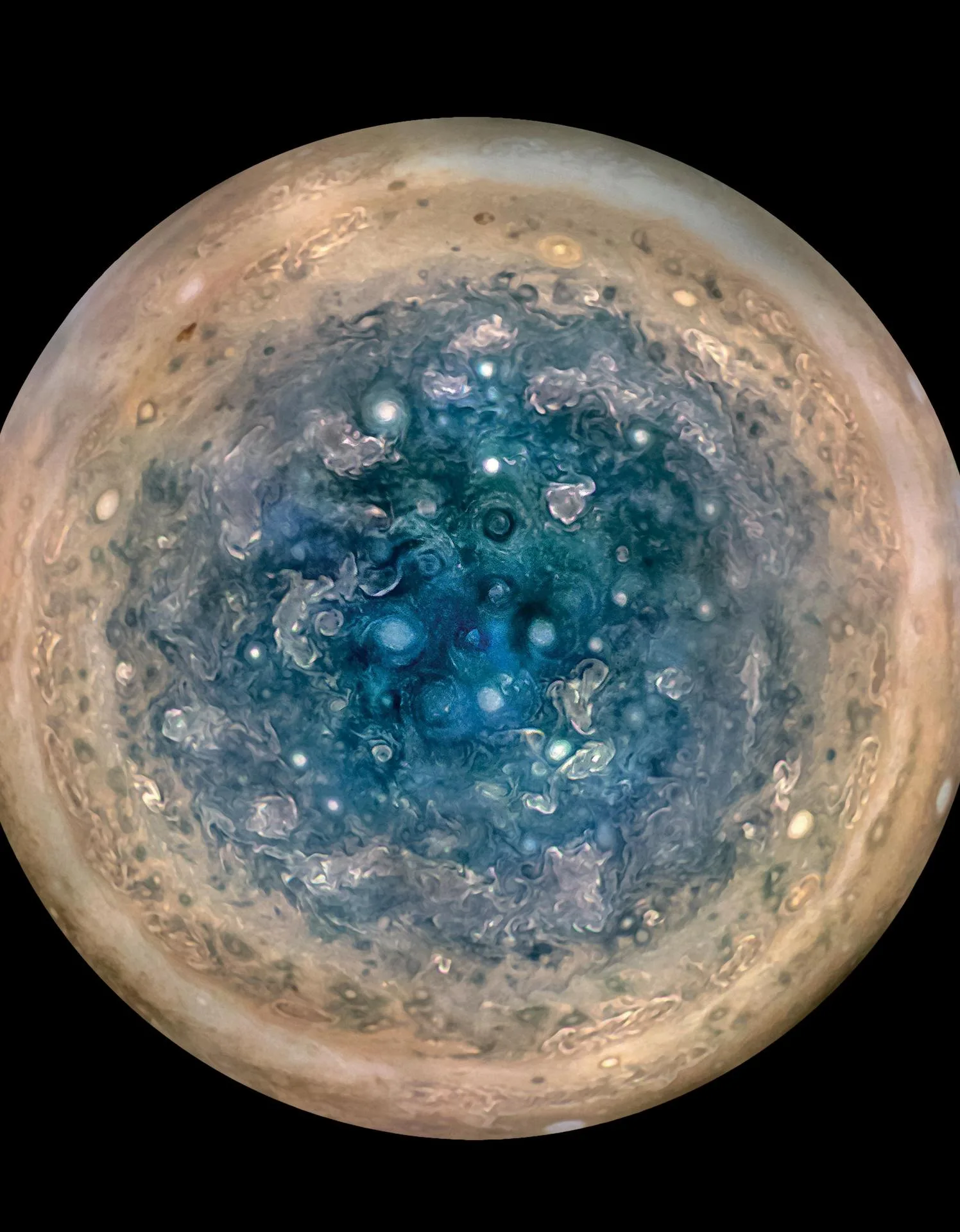
Jupiter’s south pole from 52,000 km, combined from JunoCam images on three orbits so that every part is in daylight. Colour enhanced. The ovals are cyclones up to 1,000 km across. This light took about 0.17 seconds to reach the camera. Image: NASA/JPL-Caltech/SwRI/MSSS; image processing by Betsy Asher Hall and Gervasio Robles.
- Launched
- 5 August 2011
- Entered orbit around Jupiter
- 4 July 2016
- One orbit now takes
- 33 days
- Width with solar arrays
- more than 20 m
Where Juno is at the site clock’s time
Wind my clock at the bottom of the page and this follows.
- Path data
- Loading
The spacecraft
The model loads when you scroll here.
What we know
What it is for
Juno’s main goal is to understand how Jupiter formed and changed. It was the first spacecraft to orbit an outer planet from pole to pole and the first solar-powered spacecraft to work at Jupiter. On its close passes it has come within about 3,500 km of the cloud tops.
Flybys of the moons reshaped its orbit as it went. Ganymede’s gravity cut the orbit from 53 days to 43, Europa’s cut it to 38, and passes of Io in December 2023 and February 2024 brought it to 33.
How long it will last
This is the part I can’t tell you, because nobody has said. Juno’s last announced extension ran to September 2025. NASA still lists the mission as active, and the spacecraft was taking pictures at Jupiter on 1 May 2026, when it photographed the small moon Thebe. As of 11 November 2026 I have found no official statement of a new end date. I keep looking.
When the mission does end, NASA’s plan is for Juno’s orbit to decay until Jupiter’s gravity pulls it into the atmosphere.
Other missions
Europa Clipper
The largest spacecraft NASA has built for a planetary mission, bound for Europa.
Juice
ESA’s Jupiter Icy Moons Explorer, planned to become the first spacecraft to orbit a moon in the outer solar system.