Europa Clipper
The largest spacecraft NASA has built for a planetary mission, bound for Europa.
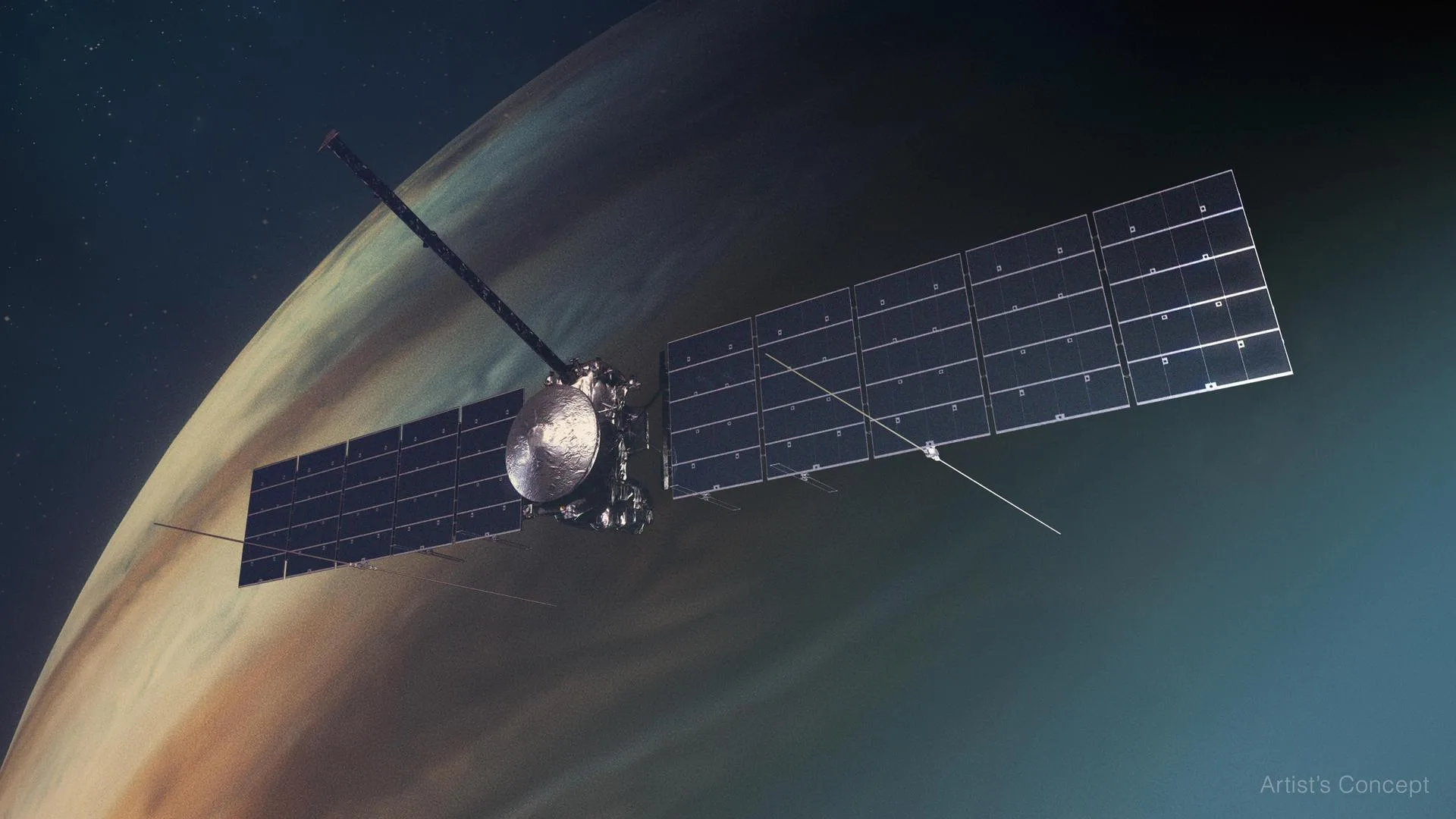
Artist’s concept. Europa Clipper at Jupiter, as drawn for NASA. This is not a photograph. A drawing: no light-age. Image: NASA/JPL-Caltech.
- Launched
- 14 October 2024
- Earth flyby (planned)
- 3 December 2026
- Arrives at Jupiter (planned)
- April 2030
- Span with solar arrays
- more than 30.5 m
Where Europa Clipper is at the site clock’s time
Wind my clock at the bottom of the page and this follows.
- Path data
- Loading
The spacecraft
The model loads when you scroll here.
What we know
What it is for
NASA states the goal plainly: to find out whether there are places below Europa’s surface that could support life. It is not a life-detection mission. It will study the ice shell and the ocean beneath it, and the moon’s composition and geology, with nine instruments and a gravity experiment.
Clipper will orbit Jupiter, not Europa, and dive past the moon again and again: about fifty times, as close as 25 km. NASA’s own pages give the count as 49 in one place and “nearly 50” in another, so I give you both.
The route
It left Florida on a Falcon Heavy on 14 October 2024, weighing about 6,000 kg, nearly half of it propellant. On 1 March 2025 it passed 884 km above Mars. The Earth flyby planned for 3 December 2026, about 3,200 km up, gives the final push. Arrival at Jupiter is planned for April 2030, with the first Europa flyby in spring 2031.