Io
The innermost of Jupiter’s four large moons, and the most volcanically active world we know.
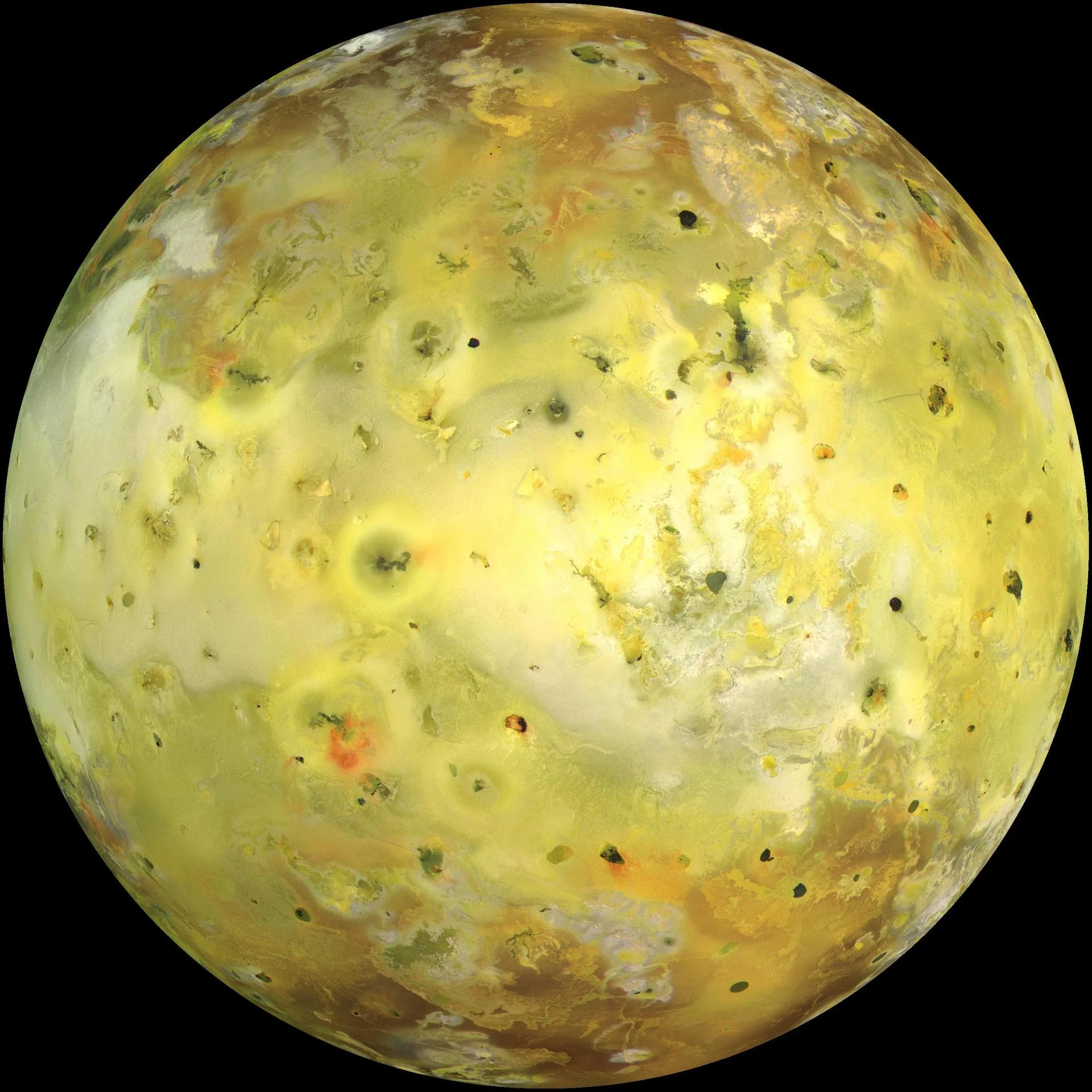
Io in true colour, from NASA’s Galileo spacecraft. The source gives no distance, so no light-age. Image: NASA/JPL/University of Arizona.
- Distance from Jupiter
- 421,800 km
- One orbit
- 1.77 days
- Diameter
- 3,643 km
- First seen as a separate moon
- 8 January 1610, by Galileo
Io at the site clock’s time
Wind my clock at the bottom of the page and this follows.
- Doing the sums
- What this is
- The United States Geological Survey’s map of Io, built from Voyager and Galileo images, wrapped on a sphere and lit from where the Sun is. Blurred or black patches are places no spacecraft has photographed well. Drag it sideways to wind time and watch it turn.
- What is simplified
- Io is drawn keeping one face exactly toward Jupiter, with its axis parallel to Jupiter’s. The real moon rocks about a degree or less either way.
Distances and Jupiter’s disc are to scale. The moons are drawn larger than life so you can see them.
- Io
- Doing the sums
- Europa
- Doing the sums
- Ganymede
- Doing the sums
- Callisto
- Doing the sums
- Io from Earth, at the site clock’s time
- Doing the sums
- Next time its shadow crosses Jupiter
- Looking
- What 70 kg on Earth would weigh there
- 12.8 kg
- From its surface gravity of 1.8 m/s² (NASA).
What we know
A world turned inside out
Io has hundreds of volcanoes, and some throw fountains of lava dozens of kilometres high. NASA calls it the most volcanically active world in the solar system.
The heat comes from being squeezed. Jupiter’s gravity pulls on Io, and its neighbours Europa and Ganymede tug at it at regular intervals. Between them they flex the moon so hard that its solid surface rises and falls by as much as 100 metres. I would not stand on it. I would not stand near it.
In step with its neighbours
Io, Europa and Ganymede keep time with one another: for each trip Ganymede makes round Jupiter, Europa makes two and Io four. That rhythm keeps their orbits slightly stretched, which is what keeps the squeezing going.
Io is a little larger than Earth’s Moon. Galileo saw it on 7 January 1610 but could not separate it from Europa until the following night.
Visitors
Pioneer 10 and 11 took the first close measurements in 1973 and 1974. In March 1979 Voyager 1 caught a volcano in the act of erupting. The Galileo orbiter studied Io on repeated flybys from 1995 to 2002, and Juno made close passes in December 2023 and February 2024.