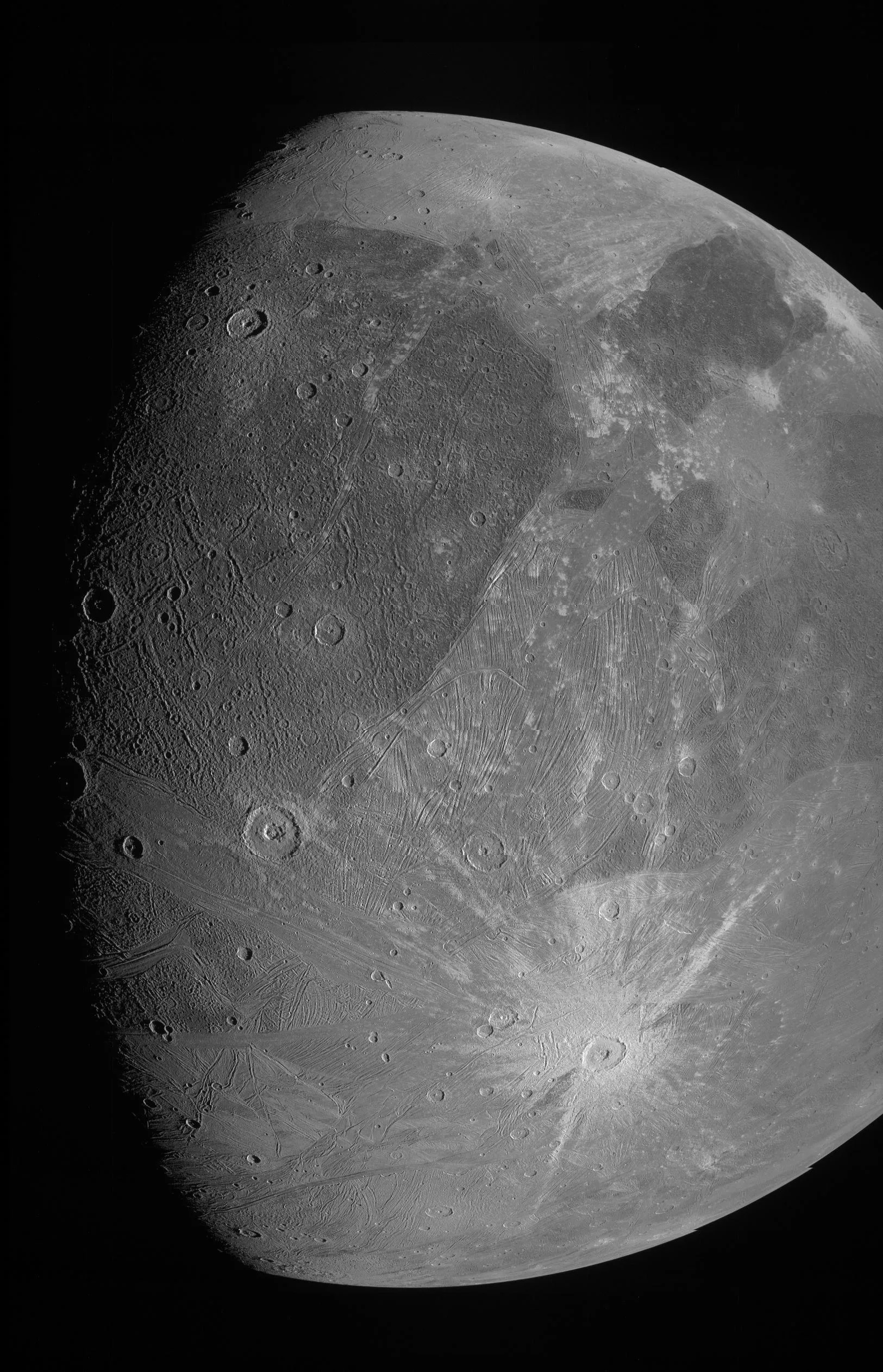
Ganymede
Bigger than the planet Mercury, and the only moon known to make its own magnetic field.
Ganymede through JunoCam’s green filter during Juno’s flyby on 7 June 2021. A preliminary image from one filter, so it is not in colour. The source gives no distance, so no light-age. Image: NASA/JPL-Caltech/SwRI/MSSS.
- Distance from Jupiter
- 1,070,400 km
- One orbit
- 7.15 days
- Diameter
- 5,262 km
- Discovered
- 7 January 1610, by Galileo
Ganymede at the site clock’s time
Wind my clock at the bottom of the page and this follows.
- Doing the sums
- What this is
- The United States Geological Survey’s map of Ganymede, built from Voyager and Galileo images, wrapped on a sphere and lit from where the Sun is. Blurred or black patches are places no spacecraft has photographed well. Drag it sideways to wind time and watch it turn.
- What is simplified
- Ganymede is drawn keeping one face exactly toward Jupiter, with its axis parallel to Jupiter’s. The real moon rocks about a degree or less either way.
Distances and Jupiter’s disc are to scale. The moons are drawn larger than life so you can see them.
- Io
- Doing the sums
- Europa
- Doing the sums
- Ganymede
- Doing the sums
- Callisto
- Doing the sums
- Ganymede from Earth, at the site clock’s time
- Doing the sums
- Next time its shadow crosses Jupiter
- Looking
- What 70 kg on Earth would weigh there
- 10.2 kg
- From its surface gravity of 1.43 m/s² (NASA).
What we know
A moon the size of a planet
Ganymede is the largest moon in the solar system, larger than Mercury and Pluto. A moon bigger than a planet. Somebody should have a word with whoever keeps the lists. It is also the only moon known to have its own magnetic field, which the Galileo spacecraft discovered in 1996.
It probably has an ocean too. The Hubble Space Telescope found what NASA calls the best evidence yet for salt water under the surface. The ocean is estimated to be about 100 km thick, beneath roughly 150 km of mostly ice, and to hold more water than all the water on Earth’s surface.
Visitors
The Pioneers, the Voyagers, Galileo, Cassini and New Horizons have all observed Ganymede. On 7 June 2021 Juno passed 1,038 km above its surface.
Ganymede is the main target of ESA’s Juice mission. After a series of flybys Juice is planned to go into orbit around it in late 2034, which would make it the first spacecraft to orbit a moon in the outer solar system.