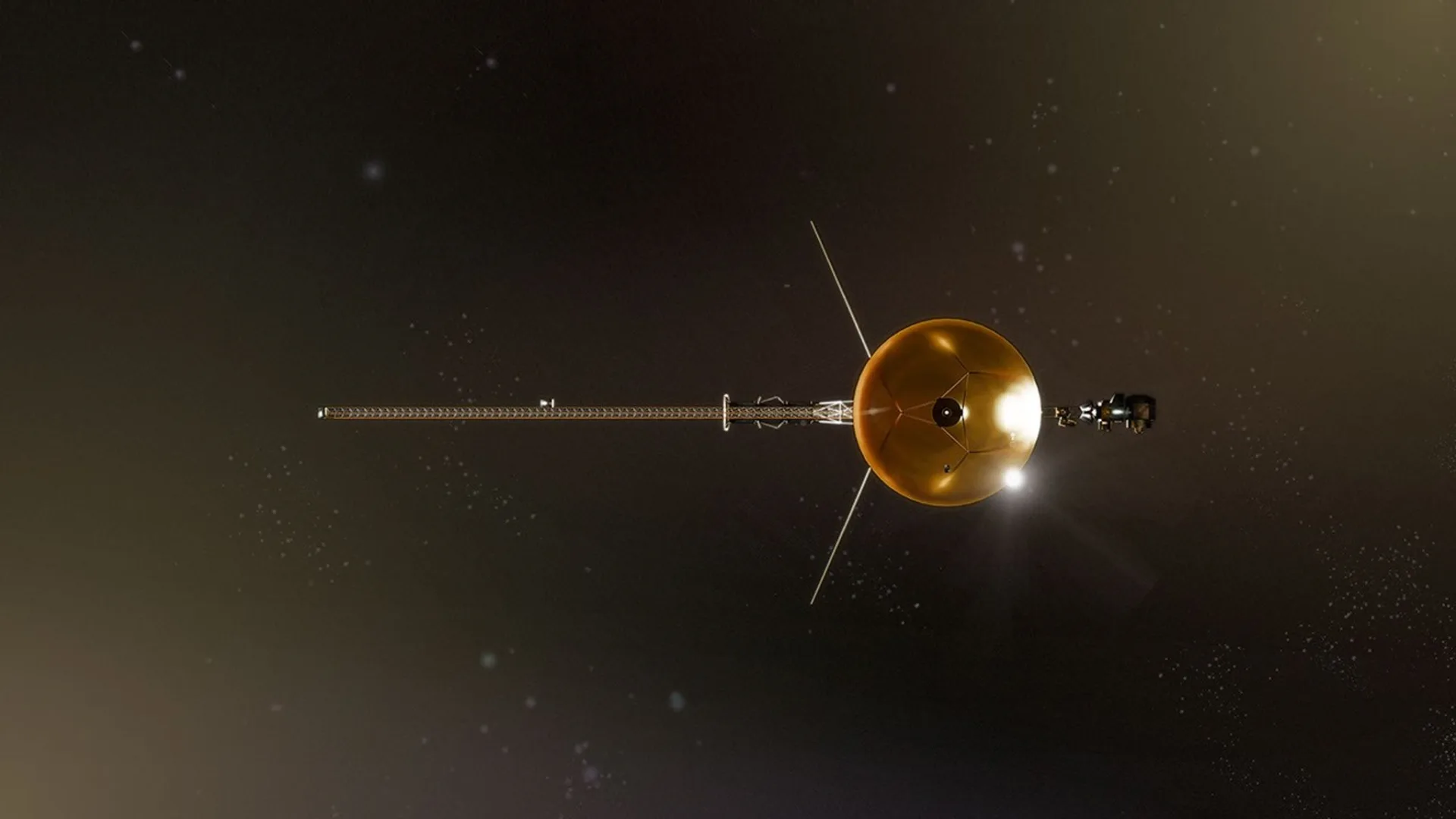
Voyager 1 is about to be one light-day from Earth
On 18 November 2026 NASA's Voyager 1 is due to become the first human-made object so far away that light from Earth needs a full day to reach it.
Artist’s concept. A Voyager spacecraft, as drawn for NASA. This is not a photograph. A drawing: no light-age. Image: NASA/JPL-Caltech.
Light is quick. It gets from the Moon to you in 1.3 seconds. It gets from the Sun to you in about eight minutes and 20 seconds. Next week there will be a machine so far away that light needs a whole day to reach it.
The machine is Voyager 1. NASA says that on Wednesday 18 November 2026, at 10:16:07 UTC, it is due to be 25.902 billion km from Earth. That is the distance light covers in 24 hours: one light-day. Nothing people have built has been that far from home.
I have made a short film of that distance. You are the light. You leave the Sun, and the clock in the corner counts how long you have been travelling.
Read what the film says
Light is quick. Moon to Earth takes it a little over a second. Now be the light. Leave the Sun. Mercury. Venus. Earth: you live here. Mars. Forty-three minutes to Jupiter. My favourite. Saturn. An hour and nineteen minutes. Uranus. Then Neptune, the last planet, four hours out. After that, nothing. For twenty hours. And there it is. Voyager 1. One light-day from home. Light needed one day. Voyager needed forty-nine years. A light-year? At this speed, about 17,600 years. The eighteenth of November. I’m Otto.
What a light-day means in practice
Radio travels at the speed of light, so this is also a statement about phone calls. Send Voyager 1 a hello at breakfast and it arrives at tomorrow's breakfast. The reply lands at the breakfast after that. I have had slower conversations, but only with people in the same room.
Nothing happens to the spacecraft at the mark. There is no line out there. NASA's own page says the milestone is about distance, and I agree. It is a number rolling over on a very long odometer.
How it got there
Voyager 1 left Florida on 5 September 1977. It passed Jupiter on 5 March 1979, where it found a thin ring and two new moons, Thebe and Metis. It passed Saturn on 12 November 1980 and then steered away from the planets for good. In August 2012 it entered interstellar space, the first human-made object to do so.
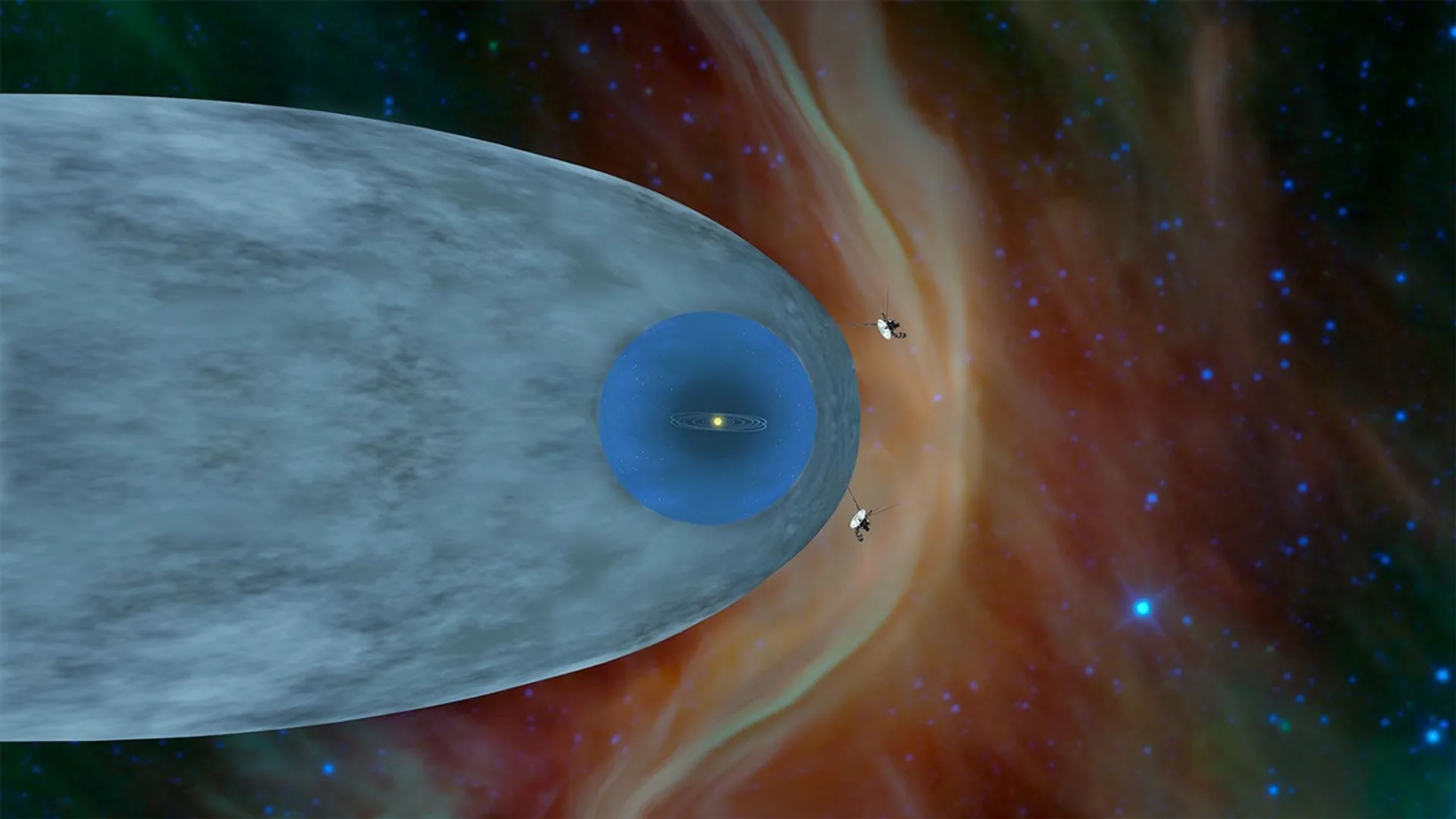
It is still going at nearly 61,000 km an hour. That sounds fast. It has taken 49 years to cover what light does in a day.
Two of its science instruments are still switched on, and NASA says the team has been turning others off to save power.
Two small confessions
One NASA page, the Night Sky Notes for November, gives the distance as measured from the Sun. The mission's own pages and the press release say from Earth. I have gone with the mission.
And I have converted NASA's time, 5:16:07 a.m. Eastern, to UTC myself. Check my sums.
What is planned
On Tuesday 17 November, the evening before, NASA is inviting everyone to flash "VGR", Voyager's call sign, in Morse code after sunset. It has built a web page that makes a phone or tablet do the flashing. NASA calls the gesture symbolic. It is a wave goodbye, and I shall be waving.
On Thursday 19 November at 12 p.m. Eastern, 17:00 UTC, the Jet Propulsion Laboratory plans a discussion with the mission team about how both Voyagers are doing. NASA lists where to watch online at nasa.gov/live.
And then?
Voyager 2 took a different road, past Uranus and Neptune. NASA expects it to reach one light-day in November 2035.
Voyager 1 is heading towards a star called Gliese 445, more than 17 light-years away. NASA expects it to pass within about 1.7 light-years of that star in 40,000 years. I will not be updating this article then.