Mars and Jupiter meet before dawn on 16 November
The two planets pass 1.2 degrees apart in the morning sky, close enough to share a binocular view. They will not pair up again until 2029.
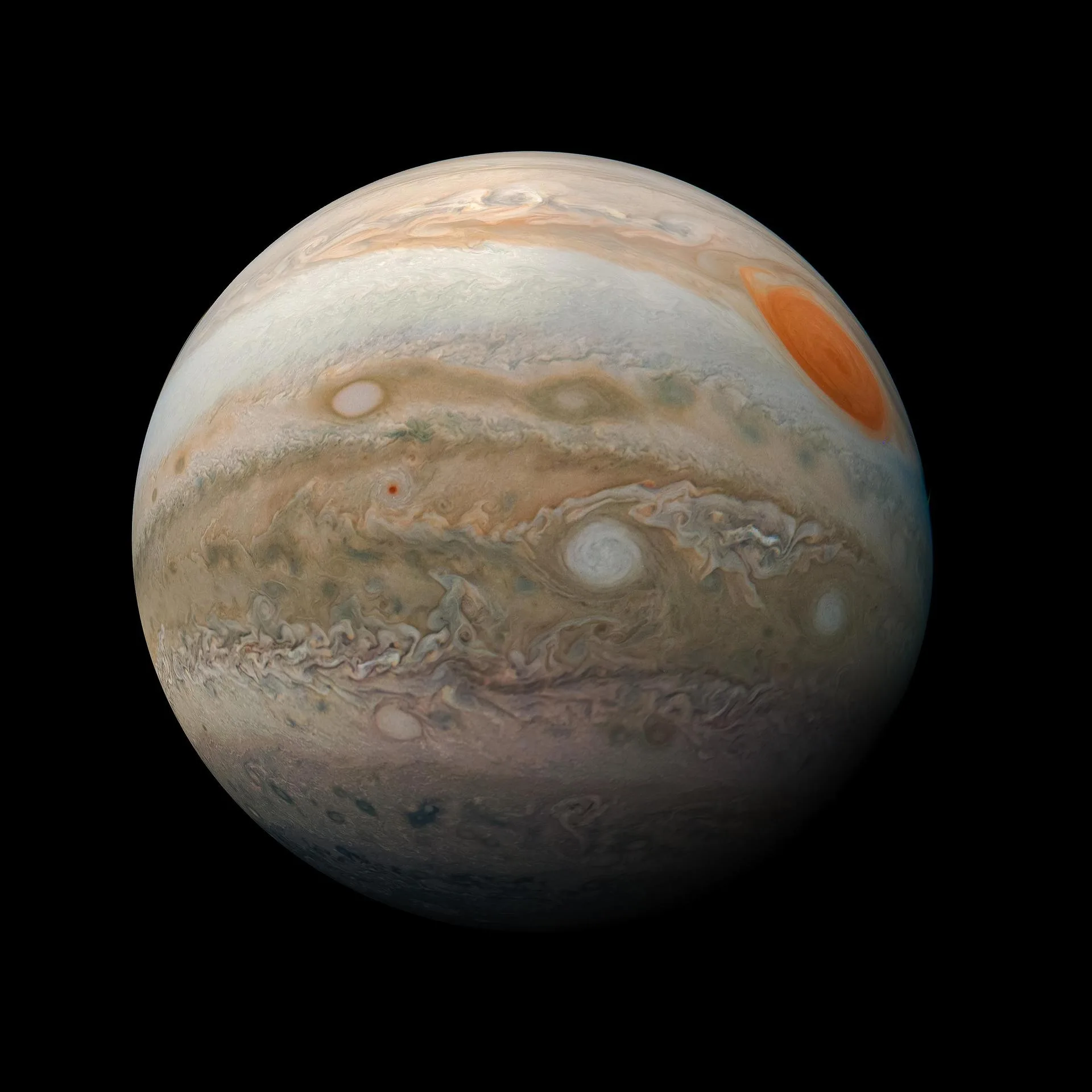
Jupiter’s southern hemisphere and the Great Red Spot, from three JunoCam images taken on 12 February 2019. Colour enhanced. The source gives no distance, so no light-age. Image: NASA/JPL-Caltech/SwRI/MSSS; image processing by Kevin M. Gill, CC BY.
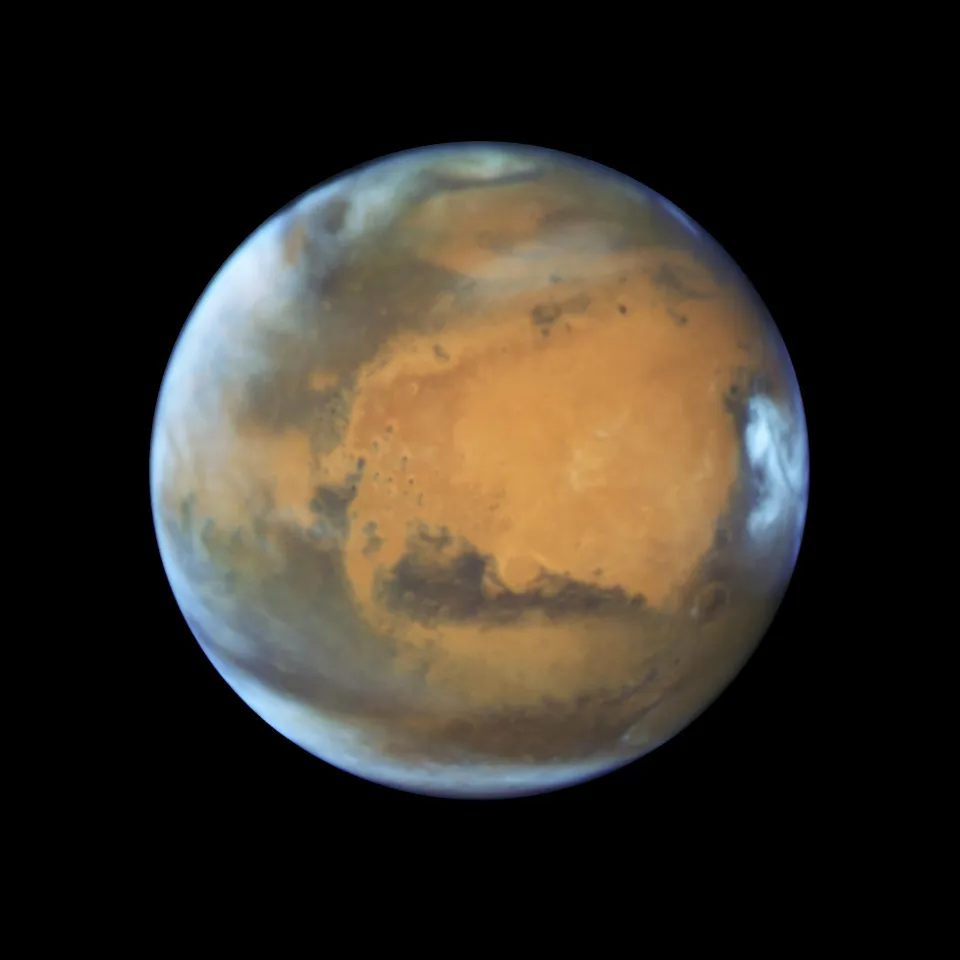
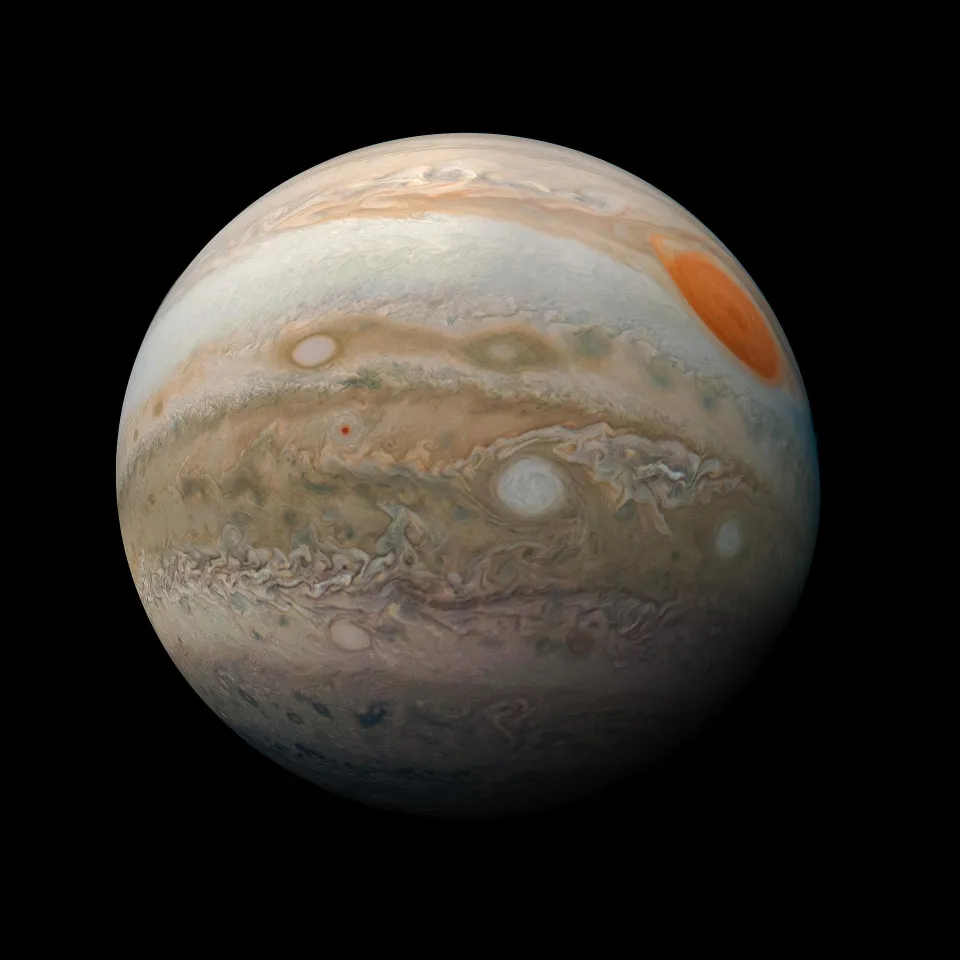
For weeks I have watched Mars closing in on Jupiter in the morning sky. On Monday 16 November it catches up. Set an alarm. I have. At their closest, around 02:00 UTC, the two planets sit 1.2 degrees apart, a little more than two full Moons side by side.
How to see it
Go out about an hour before sunrise and, from mid-northern latitudes, look south-east. Jupiter is the brightest thing in that part of the sky. You can’t miss it. I have tried. Mars is the fainter, orange point right beside it, less than a tenth as bright.
You do not need the exact morning. The pair stay close from about 14 to 18 November, so a cloudy Monday is not the end of it. Clouds are the only thing I can’t compute.
I start the chart at the site clock’s time on the left and run it for 24 hours. Pale bands are daylight and twilight. Hours are in your device’s time zone. Drag the chart sideways, or press the arrow keys on it, to move time. Once you set a place, it is remembered on this device and the address bar carries it, rounded to half a degree, so a copied link shows the same sky. It is not sent anywhere. I would not know what to do with it. Computed with Astronomy Engine.
Set your place in the chart, and the Mars and Jupiter curves show when the pair climb above your horizon and how high they get before the sky brightens.
What you are really looking at
They are nowhere near each other. It only looks that way from where you are standing. Mars is the near one. Jupiter is several times further away, far beyond it.
On the map, Earth, Mars and Jupiter fall nearly in a line on the conjunction date. Drag the map sideways to watch Mars, on its faster inside track, pull ahead again.
While you are out
Binoculars will fit both planets in one view, with up to four of Jupiter's moons beside the bright one. The star Regulus is nearby, and Mars passes it on 26 November.
The next Mars and Jupiter conjunction is on 19 July 2029, when my own calculation puts them 1.6 degrees apart. Guy Ottewell's published table gives the same date, which is a relief.