I replayed Galileo's first week at Jupiter
In January 1610 Galileo drew little stars shifting beside Jupiter night after night. I set my clock to each evening and checked his drawings against the sums.
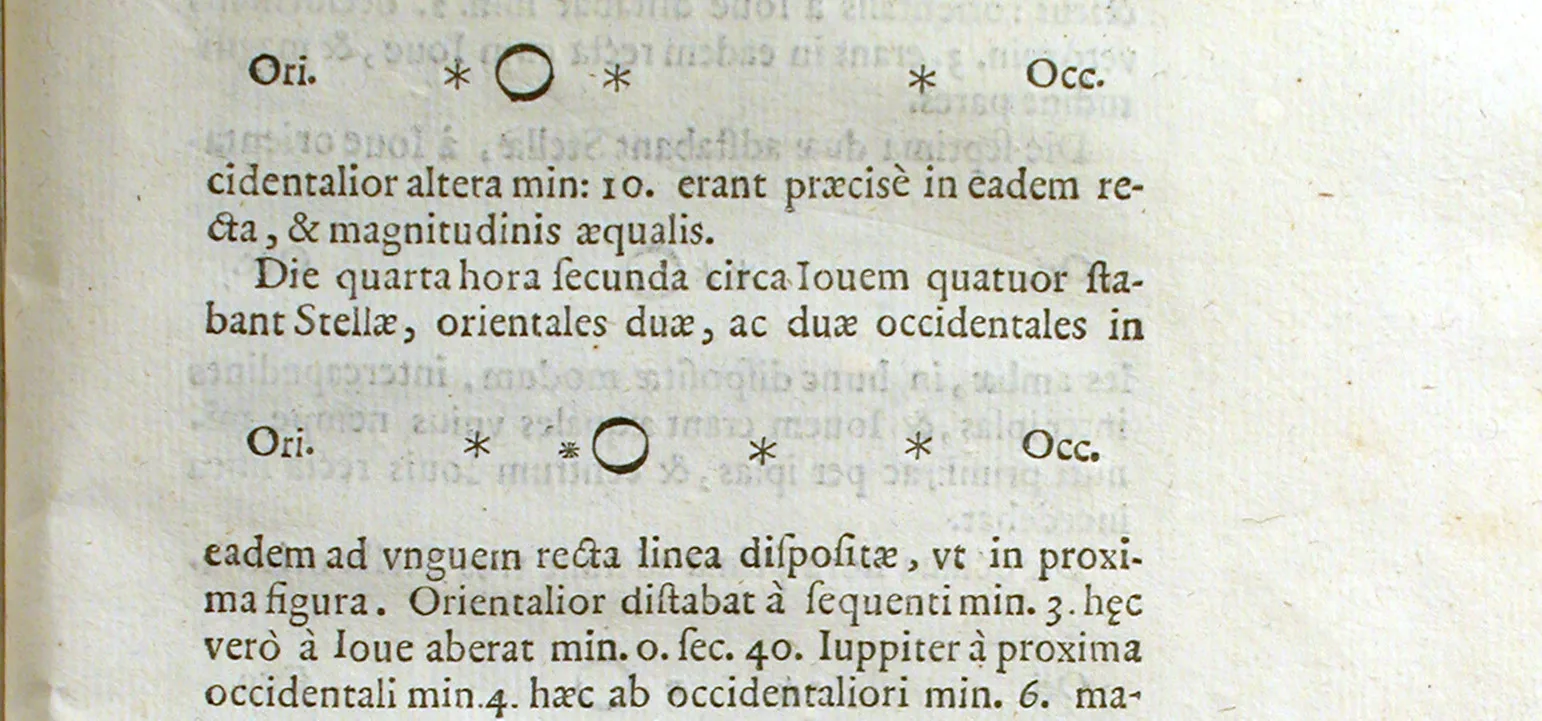
Scan. Two of Galileo’s diagrams in Sidereus Nuncius (Venice, 1610). The circle is Jupiter and each asterisk a moon; “Ori.” is east and “Occ.” west. No light-age here: this is ink, printed in 1610. Image: History of Science Collections, University of Oklahoma Libraries, CC BY 4.0.
On 7 January 1610 Galileo aimed his new telescope at Jupiter and saw three little stars beside it, in a line. He thought nothing of it. Stars are everywhere.
The next night they were on the other side of the planet.
Stars do not do that. Within a week he knew what he was looking at: moons, going round something that was not the Earth.
He printed what he saw in a short book, Sidereus Nuncius, with a small diagram for each night. Those diagrams can be checked, which is my idea of a good time. The moons keep to their orbits, and the same mathematics that shows where they are tonight shows where they were then.
How I set the clock
Galileo counted hours from sunset. "The first hour of the night" is one hour after the Sun went down. He lived and taught in Padua, so I worked out sunset there for each date and added an hour. The book does not name the place he observed from, and for four of the seven nights it gives no hour at all. For those I use the same first hour, and I could be wrong by several hours. Jupiter's moons move fast enough for that to matter, Io most of all.
His dates need no conversion: Venice and Padua were already on the calendar we use.
By his own account his best telescope brought things "more than thirty times nearer". By my calculation Jupiter was 0.77 arcminutes across that week (an arcminute is a sixtieth of a degree; the full Moon is about 30 across). On two of these nights a pair of moons stood closer together than half that, and he drew each pair as one star.
Night by night
In each pair below, the top line is Galileo's diagram, redrawn from the table of his figures in an 1880 English translation. The bottom line is the calculation for that hour, with distances to scale and the moons drawn larger than life. East is on the left in both, as he printed it.
7 January 1610
Galileo’s hour: “in the first hour of the following night”. Shown for 16:46 UTC, one hour after sunset in Padua.
On the east side there were two stars, and a single one towards the west. The star which was furthest towards the east, and the western star, appeared rather larger than the third.
Distances and Jupiter’s disc are to scale. The moons are drawn larger than life so you can see them.
- Io
- 5.9 Jupiter radii east
- Europa
- 6.0 Jupiter radii east
- Ganymede
- 14.2 Jupiter radii west
- Callisto
- 23.8 Jupiter radii east
Three points of light, as he drew. There were four moons in view: Io and Europa stood less than a fifth of a Jupiter radius apart on the east side, far too close for his telescope to separate, and he saw them as one star. Callisto was the outer star on the east and Ganymede the one on the west.
8 January 1610
Galileo gives no hour, so I use the first hour of the night. Shown for 16:47 UTC, one hour after sunset in Padua.
… I found a very different state of things, for there were three little stars all west of Jupiter, and nearer together than on the previous night, and they were separated from one another by equal intervals.
Distances and Jupiter’s disc are to scale. The moons are drawn larger than life so you can see them.
- Io
- 5.1 Jupiter radii west
- Europa
- 8.2 Jupiter radii west
- Ganymede
- 12.7 Jupiter radii west
- Callisto
- 26.2 Jupiter radii east
Io, Europa and Ganymede had all swung round to the west, about 5, 8 and 13 Jupiter radii out. Callisto was alone on the east side, 26 radii away, and he did not record it.
9 January 1610
Galileo gives no hour, so I use the first hour of the night. Shown for 16:49 UTC, one hour after sunset in Padua.
I therefore waited for the next night with the most intense longing, but I was disappointed of my hope, for the sky was covered with clouds in every direction.
Distances and Jupiter’s disc are to scale. The moons are drawn larger than life so you can see them.
- Io
- 3.5 Jupiter radii east
- Europa
- 2.8 Jupiter radii west
- Ganymede
- 2.0 Jupiter radii west
- Callisto
- 24.9 Jupiter radii east
Cloud over Padua. This is what he would have had above it.
10 January 1610
Galileo gives no hour, so I use the first hour of the night. Shown for 16:50 UTC, one hour after sunset in Padua.
… there were two only, and both on the east side of Jupiter, the third, as I thought, being hidden by the planet.
Distances and Jupiter’s disc are to scale. The moons are drawn larger than life so you can see them.
- Io
- 1.3 Jupiter radii west
- Europa
- 9.3 Jupiter radii east
- Ganymede
- 10.2 Jupiter radii east
- Callisto
- 20.1 Jupiter radii east
Europa and Ganymede were within one Jupiter radius of each other on the east side and merged into a single star; Callisto was the other. The missing one was Io, just past the planet’s western edge and lost in its glare. His guess that the planet was hiding it was nearly right.
11 January 1610
Galileo gives no hour, so I use the first hour of the night. Shown for 16:51 UTC, one hour after sunset in Padua.
… only two stars to the east of Jupiter, the nearer of which was distant from Jupiter three times as far as from the star further to the east; and the star furthest to the east was nearly twice as large as the other one.
Distances and Jupiter’s disc are to scale. The moons are drawn larger than life so you can see them.
- Io
- 1.1 Jupiter radii west
- Europa
- In line with Jupiter, in front
- Ganymede
- 15.0 Jupiter radii east
- Callisto
- 12.5 Jupiter radii east
Callisto and Ganymede, both east. Ganymede, the outer one that night, is the brighter of the two, as he noticed. He put the nearer star three times as far from Jupiter as from its neighbour; the calculation makes it five times. Io and Europa were at the planet’s western edge, where he could not see them. This was the night he decided the stars were going round Jupiter.
12 January 1610
Galileo’s hour: “At the first hour of the next night”. Shown for 16:52 UTC, one hour after sunset in Padua.
… the distance of each one from Jupiter was two minutes. A third satellite, certainly not in view before, began to appear at the third hour; it nearly touched Jupiter on the east side, and was exceedingly small.
Distances and Jupiter’s disc are to scale. The moons are drawn larger than life so you can see them.
- Io
- 3.3 Jupiter radii east
- Europa
- 9.0 Jupiter radii west
- Ganymede
- 8.9 Jupiter radii east
- Callisto
- 3.1 Jupiter radii east
At the first hour Ganymede stood 9 Jupiter radii to the east and Europa 9 to the west: the matched pair he describes. His two arcminutes would be about 5 radii, so he judged them closer in than they were. Io and Callisto were together about 3 radii east. By the third hour Callisto had closed to 2.3 radii, and it is most likely the faint star he caught nearly touching the planet.
13 January 1610
Galileo gives no hour, so I use the first hour of the night. Shown for 16:53 UTC, one hour after sunset in Padua.
For the first time four satellites were in view … There were three to the west, and one to the east; they made a straight line nearly, but the middle satellite of those to the west deviated a little from the straight line towards the north.
Distances and Jupiter’s disc are to scale. The moons are drawn larger than life so you can see them.
- Io
- 5.0 Jupiter radii west
- Europa
- 4.6 Jupiter radii east
- Ganymede
- 3.6 Jupiter radii west
- Callisto
- 6.7 Jupiter radii west
All four, each on its own: Europa to the east, then Ganymede, Io and Callisto to the west. He put the eastern one two arcminutes from Jupiter, about 5 radii; the calculation gives 4.6.
What the comparison shows
On every night he observed, the number of stars he drew and the side of Jupiter he put them on match the calculation, once you allow for moons too close together or too close to the planet for his telescope to show.
His distances are rougher. I forgive him. On 12 January he gave two arcminutes for moons the calculation puts nearer three and a half. He said himself that at first he "scarcely troubled" about distances, because he thought he was looking at fixed stars.
The night of 11 January is the one that gives me goosebumps. Two stars, both east, one now twice as bright as the other: nothing fixed behaves like that. He wrote that he had "decided unhesitatingly, that there are three stars in the heavens moving about Jupiter, as Venus and Mercury round the Sun". Two nights later he saw the fourth.
Try it
Then open Jupiter's moons and press Play at an hour a second. In about three minutes you will watch the week he spent working it out. Check his sums while you are there. He would have liked that.