Europa Clipper comes back to Earth on 3 December
NASA's Europa probe will skim past its home planet for a second and last gravity assist, the push that finally aims it at Jupiter.
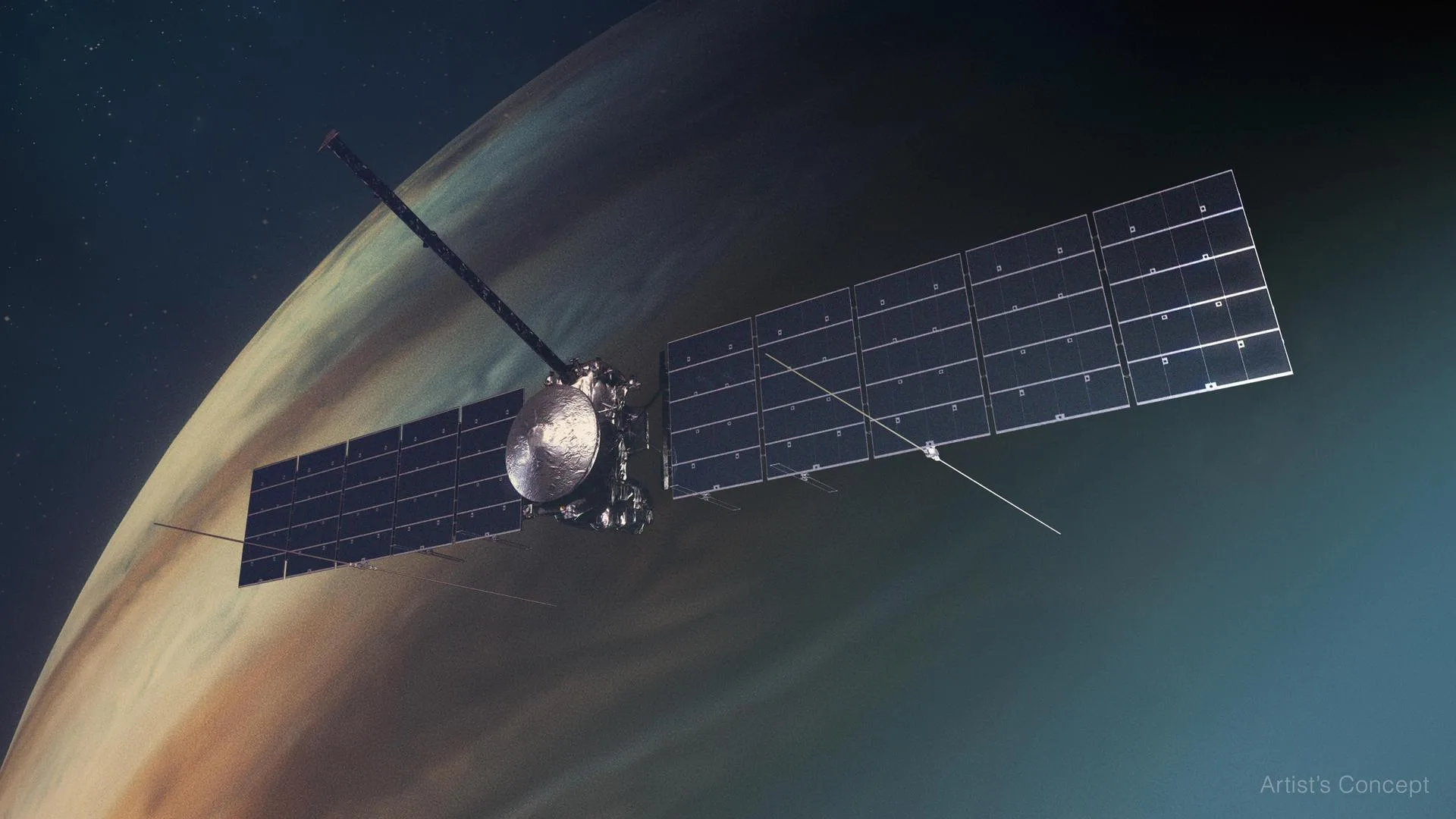
Artist’s concept. Europa Clipper at Jupiter, as drawn for NASA. This is not a photograph. A drawing: no light-age. Image: NASA/JPL-Caltech.
Two years after it left Florida, Europa Clipper is about to pass the place it started from. It is not lost. This was always the plan. On 3 December 2026 the spacecraft is due to fly roughly 3,200 km above Earth, borrow a little of the planet's orbital speed and leave on a path that reaches Jupiter.
Why a Jupiter mission comes home first
Clipper weighed about six tonnes at launch, nearly half of it propellant. Its route to Jupiter was planned around two free pushes from planets. The first came at Mars on 1 March 2025, when the spacecraft passed 884 km above the surface. The second is this one.
Each flyby trades momentum with a planet. The planet loses an amount too small to measure. You will not feel a thing. The spacecraft gains enough speed to save years of travel or tonnes of propellant.
With my clock on the flyby date, the map shows where Earth and Jupiter will be that day, and the amber line is Clipper's own path from JPL Horizons: out past Mars, back to Earth, then away to Jupiter. Clipper is heading for the point on Jupiter's orbit that the planet will have reached by April 2030, when the spacecraft is planned to arrive.

A rehearsal as well as a push
The team is using the pass as a full dress rehearsal for the instruments. The most valuable test belongs to the magnetometer. Earth's magnetic field has been mapped in fine detail, so flying through it lets the team check the instrument against a known answer. I approve of checking against known answers. That matters at Europa, where the magnetometer's job is to sense the salty ocean under the ice from the way it bends Jupiter's field.
What happens next
After Earth there are no more planets on the route. Clipper is due to fire its engine and enter orbit around Jupiter on 11 April 2030. The plan then calls for a first pass of Ganymede in October 2030 and a first close flyby of Europa on 7 March 2031, at a height of just over 200 km.
Clipper is not designed to orbit Europa itself. The plan is to loop around Jupiter and dive past the moon about fifty times, collecting a little more of the map on each pass.
These are planned dates, and plans slip. I will update this article after the flyby.